§4–7 · Protocol

Protocol Architecture

Pustaron has three functional layers. They sit on a canonical ledger and share a set of services that run through all of them.

Architecture

The Three-Layer Stack

Access

Where contributors, enterprises and institutions join, accept tasks and submit data.

Licensing & settlement

Issues licenses, meters use, settles fees in PSRN and routes compensation.

Attestation

Records consent, removes identifying information, checks quality and converts submissions into published schemas.
Ingestion

Access Layer and the Ingestion Pipeline

Every submission passes through consent, on-device checks, de-identification, validation sampling, standardization and commitment before it becomes licensable.

Consent

The contributor signs a consent receipt with a device-bound key.

Validation sampling

Bonded validators review a statistically sized sample — fluent speakers where required.

Standardization

Accepted items are converted to the task’s published schema.

Commitment

Each shard is hashed; the dataset manifest is committed to the ledger and becomes licensable.

Trust

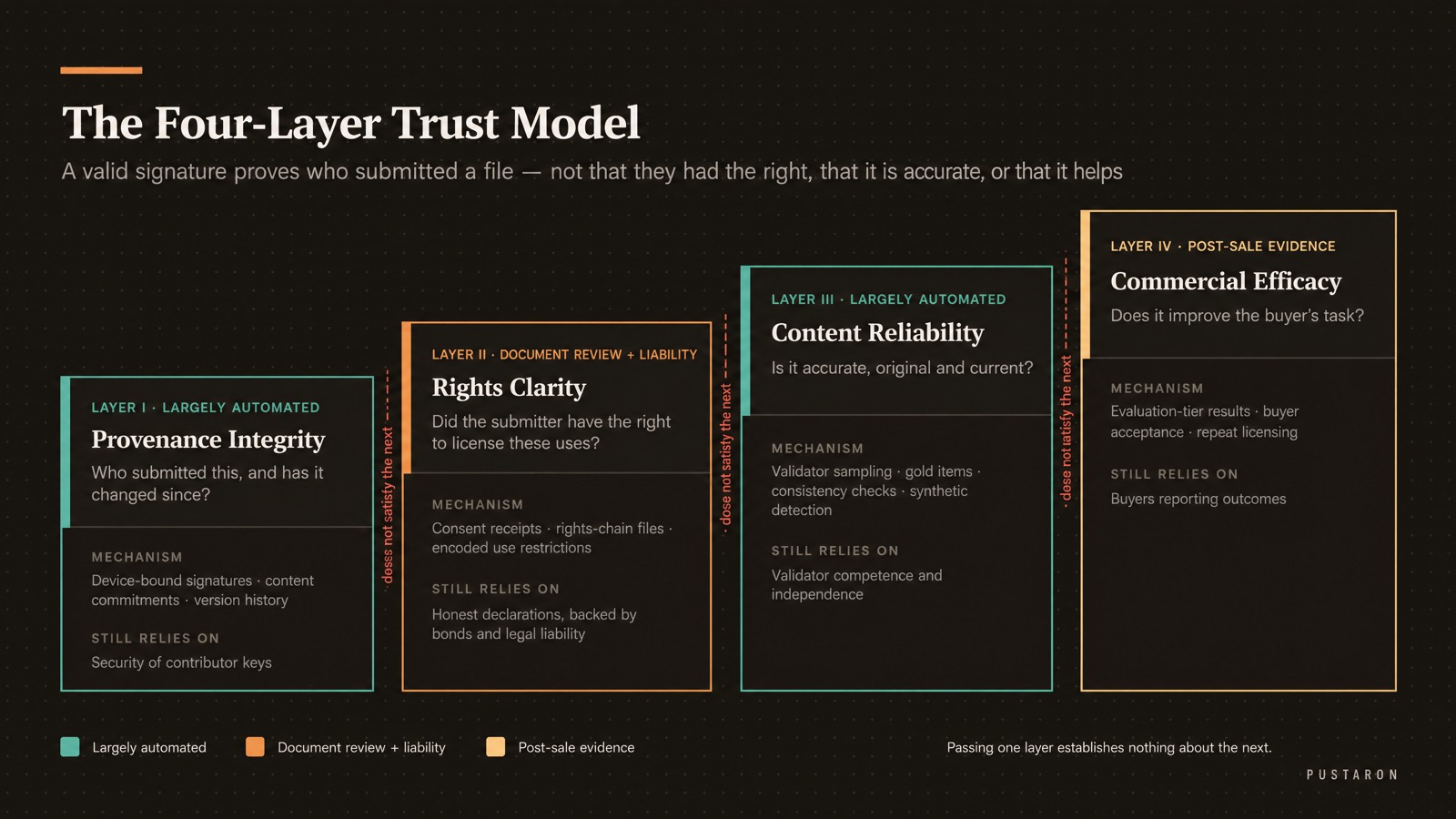
The Four-Layer Trust Model

A cryptographic signature proves who submitted a file. It does not prove that the submitter had the right to license it, that the content is accurate, or that it will improve anyone’s model. Pustaron splits trust into four layers — provenance, rights, reliability and efficacy — each checked by its own mechanism.

Fig · Provenance · Rights · Reliability · Efficacy

DNA

Decentralized Node Alliances (DNA)

These are protocol-level collectives grouped around a language, a sector or an institution. Members pool datasets, negotiate license terms and share stewardship duties. Anyone with a phone can still participate alone. Alliances exist because one contributor has almost no leverage with a frontier lab, while a thousand contributors bound by one charter have a great deal.

Licensing

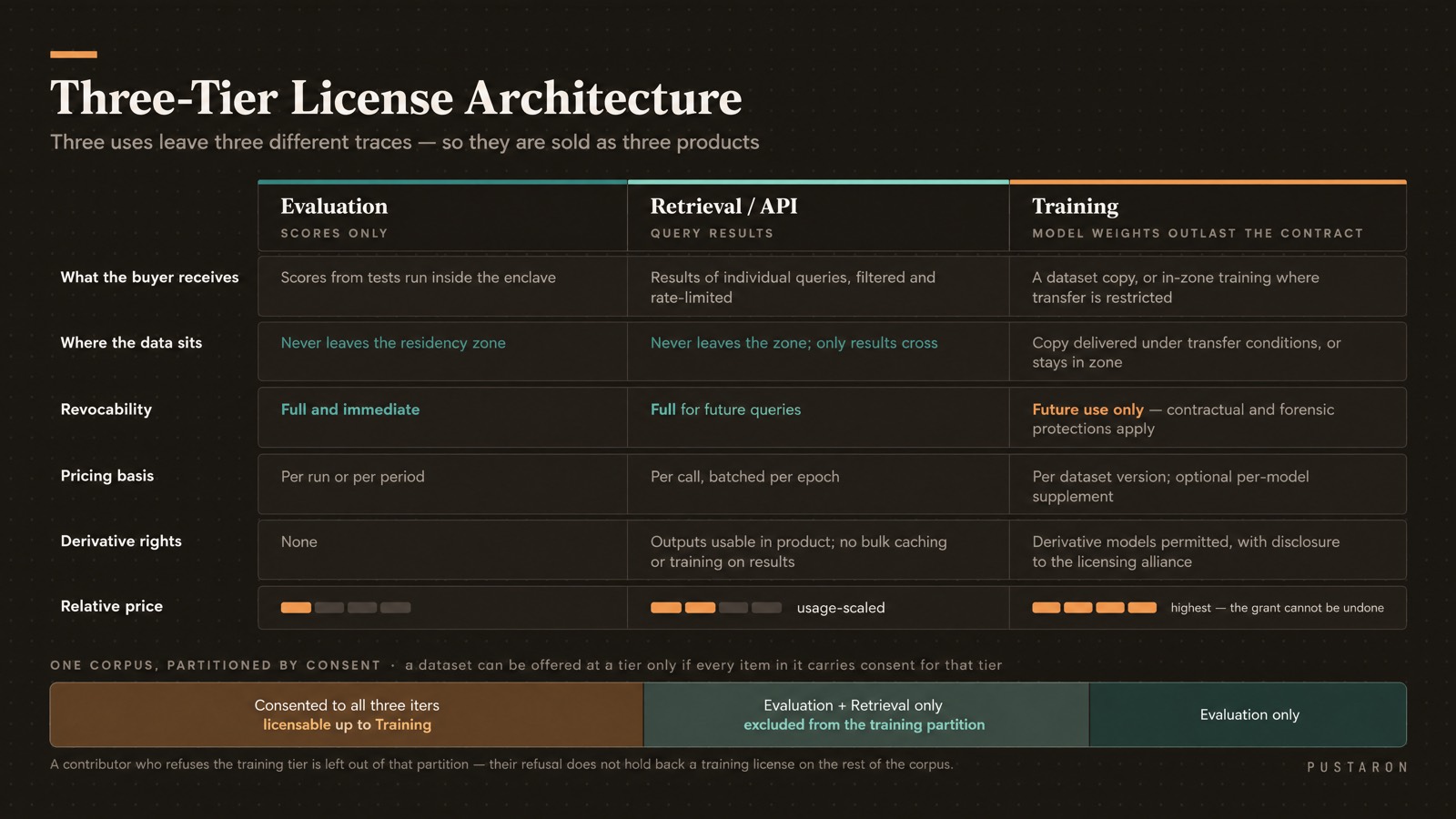
Evaluation · Retrieval · Training

Licensing is organized in three tiers with different rights and pricing. Consent receipts state which tiers a contributor accepts. Agent-callable endpoints support per-query settlement as purchasing shifts toward autonomous retrieval.

Settlement rails

Gateway infrastructure

Some enterprise buyers will prefer not to hold the token. They can pay through Multi-Gateway Digital Asset Custodial Settlement or a Compliant Local Currency Gateway Interface, and the network converts the payment at the point of settlement.

Multi-Gateway Digital Asset Custodial Settlement

Qualified custodians accept supported digital assets, convert at settlement price, and deliver PSRN.

Compliant Local Currency Gateway Interface

Licensed payment institutions and regional micro-settlement — including e-wallets and QRIS standard integrations — so contributors can earn without holding PSRN.

Fig · Evaluation · Retrieval · Training